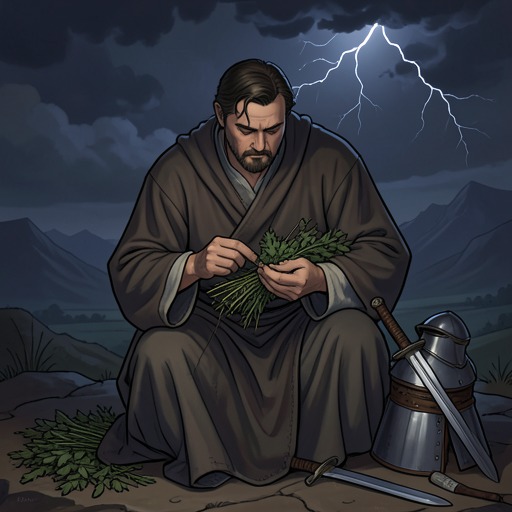
Black Bag Book
The Romance of the Three KingdomsThe Black Bag Book is the medical manuscript said to preserve Hua Tuo’s cures for every illness. Entrusted to a prison warder after Hua Tuo’s death, it is burned by the warder’s wife to light a fire; the loss turns a trove of healing knowledge into an irrecoverable absence and explains why so few of Hua Tuo’s cures survive.
Identity and Contents
The narrative presents the Black Bag Book as a great book in which Hua Tuo recorded the cures he knew. Its contents are not enumerated, and the text offers no surviving prescription from it. Instead, its extraordinary scope is conveyed through the claim that Hua Tuo knew how to cure all illnesses and had written his knowledge down. The manuscript thus stands for practical medical expertise gathered into a single, vulnerable object.
Hua Tuo’s Death and the Book’s Transfer
Hua Tuo is imprisoned after Cao Cao suspects that the physician has come to avenge Guan Yu. The suspicion follows Hua Tuo’s explanation that treating Cao Cao’s illness would require opening his skull, and his mention that he had cured Guan Yu. Although the prison warder treats Hua Tuo kindly, Hua Tuo dies shortly afterward. The account then says that he had the Black Bag Book brought and given to that warder as a gift, linking the manuscript’s final passage directly to the kindness shown to its author.
Burning and Loss
The transfer does not preserve the book. The warder’s wife uses the precious manuscript to light a fire, and the account identifies this destruction as the reason almost none of Hua Tuo’s cures have come down to the present. The book’s material purpose reverses: a record intended to preserve remedies is consumed as fuel. Its loss is not merely the disappearance of a valuable possession; it removes the written means by which Hua Tuo’s medical knowledge might have endured beyond his death.
Narrative Significance
The Black Bag Book appears in the aftermath of Hua Tuo’s imprisonment and death, giving that personal tragedy a further consequence. The story moves from the physician’s extraordinary skill to the fragile survival of what he knew: his written legacy exists, briefly passes into a sympathetic custodian’s hands, and is then destroyed in an ordinary domestic act. A poet’s praise of Hua Tuo as the greatest of physicians, able to discern a person’s very spirit, sharpens the contrast between the magnitude attributed to his skill and the near-total loss of its recorded cures. The manuscript makes that loss concrete: what cannot be recovered is not only a life, but also the knowledge it had gathered.